Skip to content

Flying Ants or Termites? How to Tell the Difference
A South Florida homeowner’s guide to identifying winged insects, understanding the risks, and protecting your property.
Why This Identification Matters
Every year, especially during periods of warm temperatures and increased humidity, South Florida homeowners notice winged insects appearing around their properties. These insects may gather near windows, outdoor lights, entryways, patios, or even emerge suddenly inside the home. For many people, the first concern is whether they are dealing with termites — a pest well known for its ability to damage wooden structures.
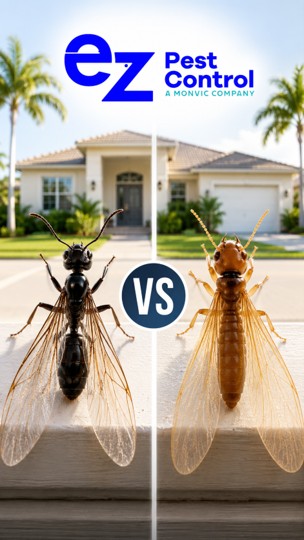
However, what many homeowners do not realize is that flying ants can look surprisingly similar to termite swarmers, making it difficult to tell the difference without a closer inspection. Both flying ants and termites produce winged reproductive members that leave established colonies in search of new locations where they can reproduce and create additional colonies. During these swarming events, large numbers of insects may appear within a short period of time, creating an alarming sight for property owners.
The Risk of Misidentification
In some cases, homeowners may become unnecessarily worried after spotting flying ants that pose little threat to the structure. In other situations, people may mistakenly assume they are seeing harmless ants when the insects are actually termite swarmers signaling the presence of a nearby colony.
South Florida’s Unique Challenge
South Florida provides ideal conditions for both termites and ants to thrive. The region’s subtropical climate allows many pest species to remain active throughout much of the year, while seasonal rainfall and humidity create favorable conditions for swarming activity. As a result, homeowners frequently encounter winged insects and often struggle to determine exactly what they are seeing.
What Are Flying Ants?
Many homeowners are surprised to learn that not all ants remain wingless throughout their lives. Most mature ant colonies eventually produce specialized reproductive ants that develop wings and participate in a natural process known as swarming. These winged ants, often referred to as alates, leave their original colony with the goal of mating and establishing new colonies elsewhere.
Carpenter Ants
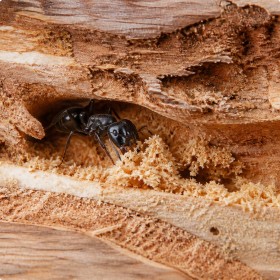
Particularly noteworthy because they are often associated with wood. Unlike termites, they do not consume wood as a food source — instead, they excavate galleries within wood to create nesting areas. When winged Carpenter Ants appear around a property, homeowners often assume they are dealing with termite activity because both insects can emerge from areas near wood.
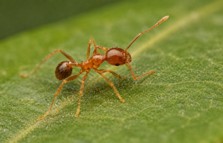
Big Headed Ants
Another species commonly found in South Florida landscapes. These ants typically establish colonies outdoors in soil and landscaped areas, but their winged reproductive forms can occasionally be seen around homes during swarming periods. Because the average homeowner rarely examines these insects closely, they are often grouped together with termite swarmers despite their significant biological differences.
Swarming typically occurs when environmental conditions become favorable for reproduction. Warm temperatures, increased humidity, and seasonal weather changes can all trigger this behavior. During a swarm, large numbers of winged ants may emerge simultaneously, often creating the impression that an infestation has suddenly appeared overnight.
One of the reasons flying ants create so much confusion is that they are often attracted to light. Homeowners may discover them gathering around windows, glass doors, porch lights, or interior lighting fixtures. This behavior is remarkably similar to what termite swarmers do during their reproductive flights, making visual identification even more important. Although the presence of flying ants does not automatically indicate a serious structural concern, it should not be ignored entirely — their appearance may signal that a mature colony exists somewhere nearby.
What Are Termite Swarmers?
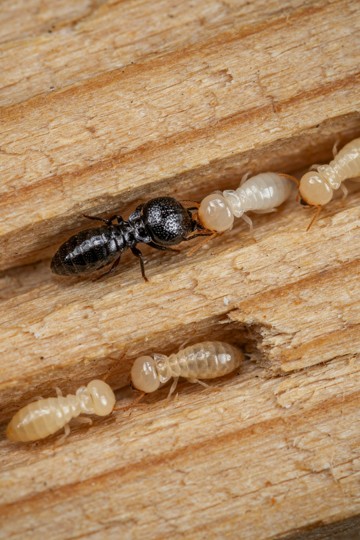
Just as ant colonies produce winged reproductive members, termite colonies also generate specialized individuals whose primary purpose is to establish new colonies. These insects are known as termite swarmers, and their appearance is often one of the earliest visible signs that a termite colony may be present nearby. While swarmers themselves do not cause structural damage, they serve as an important warning signal that homeowners should take seriously.
Subterranean Termites
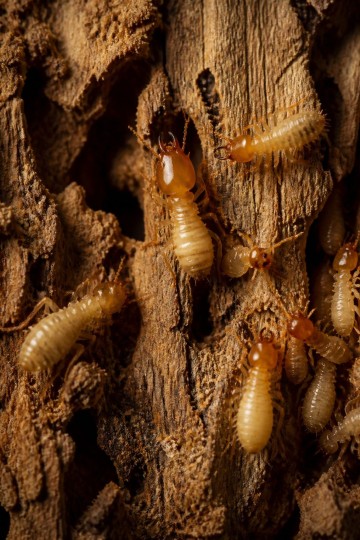
Typically live in colonies located in the soil. These termites require access to moisture and often travel between the ground and wooden structures through protective shelter tubes. Because their colonies are hidden underground, homeowners may remain unaware of their presence until visible signs of activity begin to appear. Swarming events often provide one of the first indications that a colony may exist somewhere on or near the property.
Drywood Termites
Behave differently because they do not require contact with soil. Instead, they establish colonies directly within dry wood and can infest structural components, trim, doors, furniture, and other wooden elements. Since they live inside the wood they consume, their activity may remain concealed for extended periods. Swarmers emerging from walls, ceilings, or window frames can sometimes be the first visible clue that an infestation exists.
What Triggers a Swarm?
Environmental conditions play a major role in triggering swarming behavior. Warm temperatures, elevated humidity levels, and seasonal weather patterns commonly found throughout South Florida create ideal conditions for termite swarms. As a result, homeowners frequently encounter winged termites during certain times of the year, particularly following periods of rainfall or increased moisture.
Warning Signs After a Swarm
One of the most common signs after a swarm is the presence of discarded wings. Since termites shed their wings shortly after landing and establishing a new nesting site, piles of wings near windowsills, entryways, or other indoor locations can indicate that swarmers have recently been present. Repeated swarming activity or unexplained insect activity around windows and doors should never be dismissed without further evaluation.
Antennae Shape
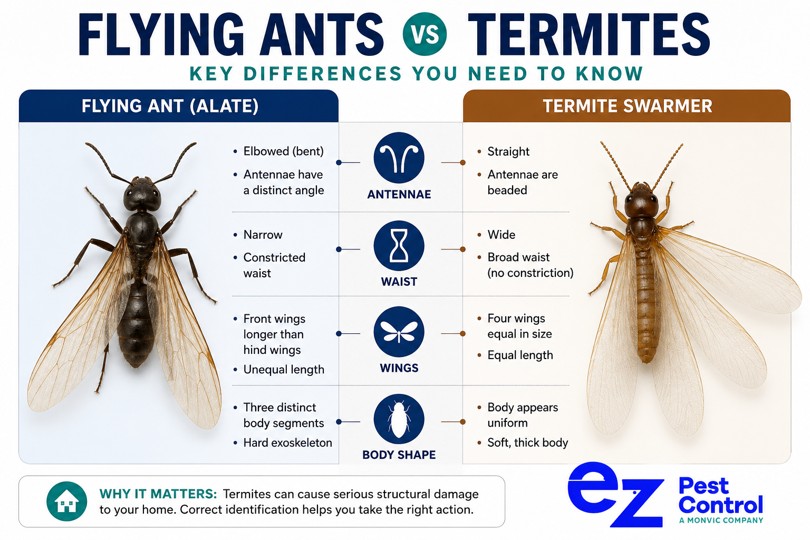
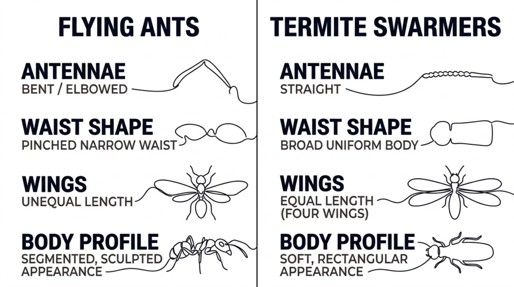
Flying ants have distinctly bent or elbowed antennae that angle outward from the head. This bend is often noticeable even when viewing the insect from a short distance. Termites, by contrast, have straight antennae that appear more uniform in shape — one of the most reliable ways to tell the two insects apart.
Body / Waist Shape
Flying ants have a clearly defined pinched waist between the thorax and abdomen, giving them a sculpted body profile. Termites lack this constricted waist — their bodies appear broader and more uniform from front to back, creating a straighter and more rectangular overall shape.
Wing Size & Symmetry
Flying ants possess two pairs of wings that are unequal in size — the front wings are typically larger than the rear wings. Termite swarmers have four wings of approximately equal length. This symmetrical wing structure is one of the most distinctive characteristics of termite reproductives.
Overall Appearance
Flying ants often display a more segmented and defined body structure, while termites generally appear softer and more uniform. Coloration may vary by species, making it less reliable as a sole identification factor. Professionals rely more heavily on body shape, wing characteristics, and antennae structure.
When multiple identifying features are considered together, the distinction becomes much clearer. Looking at the antennae, waist shape, and wings simultaneously can provide a strong indication of whether the insects are flying ants or termite swarmers.
Why Homeowners Frequently Confuse Them
If flying ants and termite swarmers have several physical differences, many homeowners wonder why they are so often mistaken for one another. The answer is simple: both insects appear under very similar circumstances. They emerge during reproductive swarms, possess wings, gather around light sources, and often appear suddenly in large numbers.
▶️ Similar Environmental Triggers
South Florida’s warm temperatures and high humidity create favorable conditions for both ants and termites throughout much of the year. During periods of increased rainfall, especially in spring and summer, swarming activity becomes more common. Since both ants and termites respond to similar environmental triggers, their swarms can occur during overlapping time periods.
▶️ Shared Attraction to Light
Flying ants and termite swarmers are commonly found around windows, glass doors, outdoor lighting, and illuminated rooms. Homeowners may discover dozens of insects gathered near a sliding glass door or notice discarded wings accumulating on a windowsill. Without closely examining the insects themselves, it is often impossible to determine whether they are ants or termites based solely on where they were found.
▶️ Speed of Swarming Events
Swarms often appear suddenly and disappear just as quickly. A homeowner may leave for work in the morning and return home to find winged insects near a window or a pile of wings on the floor. Because the insects are sometimes gone by the time they are noticed, property owners may only have limited evidence available for identification.
▶️ Public Perception & Awareness
Termites are widely known for their ability to damage structures, so many homeowners automatically associate any winged insect with termite activity. Flying ants receive far less attention, despite being a common occurrence throughout South Florida. As a result, many people have never learned the visual differences between the two insects and rely solely on the presence of wings when making assumptions.
Which One Is More Dangerous for Your Home?
One of the first questions homeowners ask after discovering winged insects is whether they should be worried about damage to their property. The answer depends largely on whether the insects are flying ants or termite swarmers. Although both deserve attention, the level of concern and the type of risk they present can be very different.
LOWER STRUCTURAL RISK
Flying Ants
Environmental conditions play a major role in triggering swarming behavior. Warm temperatures, elevated humidity levels, and seasonal weather patterns commonly found throughout South Florida create ideal conditions for termite swarms. As a result, homeowners frequently encounter winged termites during certain times of the year, particularly following periods of rainfall or increased moisture.
HIGHER STRUCTURAL RISK
Termite Swarmers
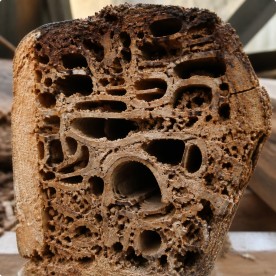
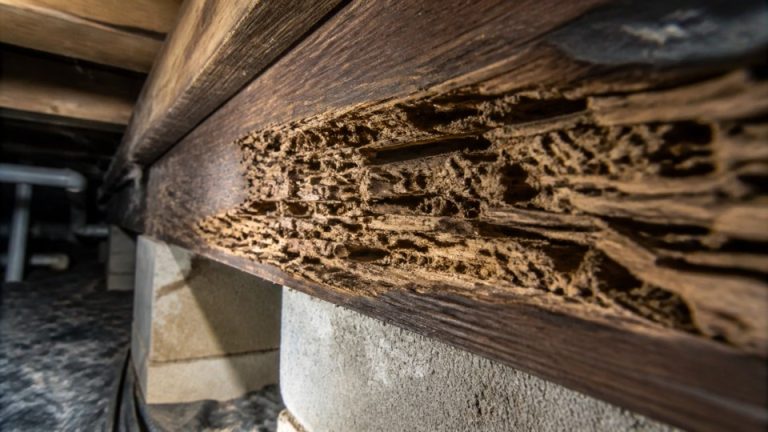
Termites present a different level of concern because their colonies feed on materials containing cellulose, including structural wood. Over time, termite activity can compromise wooden components within a building if left undetected. One of the challenges associated with termites is that they often work from concealed locations — damage may develop inside walls, beneath flooring, or within structural elements long before homeowners notice visible warning signs. The swarmers themselves do not damage wood, but their presence may indicate that an established colony exists somewhere nearby.
Homeowners should avoid drawing conclusions based solely on appearance. Rather than assuming the insects are harmless or immediately concluding that extensive damage exists, a professional assessment can provide a clearer understanding of the situation and help determine whether any corrective action is necessary.
What Should You Do If You Find Flying Insects Indoors?
Discovering winged insects inside a home can be unsettling, especially when homeowners are unsure whether they are dealing with flying ants or termite swarmers. A more methodical approach is often the best course of action — gathering information and looking for additional evidence can help provide a clearer picture of what may be occurring.
Avoid Guessing — Observe Carefully
Although the physical differences between flying ants and termites are relatively straightforward once understood, identification can still be challenging during an active swarm. Insects may be damaged, moving rapidly, or located in difficult-to-access areas. A mistaken identification can lead homeowners to either underestimate or overestimate the seriousness of the situation.
Note Where Insects Were Found
Observe where the insects were found and whether there are any additional signs of activity nearby. Discarded wings around windows, doors, or light fixtures can indicate that a swarm recently occurred. Pay attention to recurring insect activity in the same area, as repeated sightings may suggest an established colony nearby.
Look for Additional Evidence
In the case of termites, homeowners may notice shelter tubes, damaged wood, or accumulations of discarded wings. Drywood termite activity may sometimes be accompanied by small pellet-like droppings known as frass. For ants, Carpenter Ant activity may occasionally be associated with wood shavings or debris generated as they excavate nesting galleries.
Document What You Observed
Taking photographs of the insects, wings, or affected areas can provide valuable information for a professional inspection. Since swarming events are often temporary, photographs may become one of the few pieces of evidence available once the insects have disappeared.
Contact a Professional
Winged insects often represent only a small part of a much larger colony. The insects visible during a swarm are the reproductive members, not the workers responsible for maintaining the colony. Eliminating the insects that are immediately visible does not necessarily address the source of the activity. Understanding where the insects originated and what species is involved remains the key to determining whether further action is needed.
How to Reduce the Chances of Future Infestations
While no property can be completely protected from every pest, there are several practical steps homeowners can take to reduce the likelihood of future ant and termite activity. Prevention focuses on making the property less attractive to pests and addressing conditions that may support colony development.
Moisture Management
Excess moisture creates favorable conditions for many pest species and can contribute to wood deterioration that attracts both ants and termites. Promptly repair leaks, improve drainage, and reduce standing water around the property to eliminate conditions that encourage pest activity.
Seal Entry Points
Inspect the exterior of the structure for potential entry points. Small gaps around doors, windows, utility penetrations, and foundation openings may allow insects to gain access to the home. Sealing these areas can help reduce opportunities for pests to enter and establish themselves indoors.
Routine Property Inspections
Checking attics, crawl spaces, garages, window frames, and other vulnerable areas allows homeowners to identify potential issues before they become more significant. Early discovery often makes corrective action simpler and more effective.
Maintain Landscaping
Excessive vegetation touching the structure, accumulations of organic debris, and conditions that trap moisture near the foundation can create environments that support pest activity. Keeping these areas well maintained can help reduce the attractiveness of the property to ants, termites, and other insects.
Professional Preventive Inspections
Because many forms of termite and ant activity occur in hidden locations, professional evaluations can identify warning signs that homeowners may not recognize on their own. Regular inspections help ensure that potential problems are detected before significant activity develops.
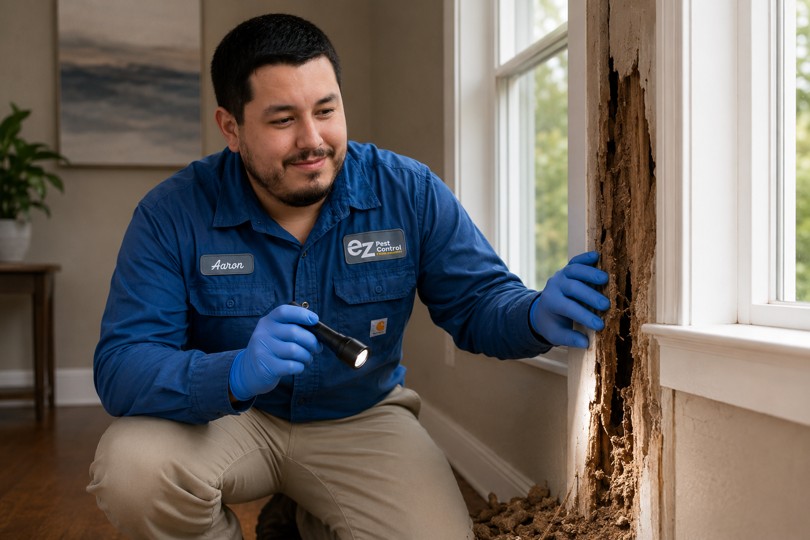
Why South Florida Homeowners Trust EZ Pest Control
When homeowners discover flying insects around their property, accurate identification is essential. Determining whether the insects are flying ants or termite swarmers requires careful observation and, in some cases, professional expertise. Because the two insects can appear very similar during swarming events, an experienced inspection can help eliminate uncertainty and provide homeowners with the information they need to make informed decisions.
Professional Identification
EZ Pest Control works with homeowners throughout South Florida to identify pest activity and evaluate conditions that may contribute to infestations. Through professional inspections and customized recommendations, the company helps property owners understand what type of pest is present and what steps may be appropriate for their specific situation.
Comprehensive Inspections
Whether the concern involves flying ants, termite swarmers, or other structural pests, early identification remains one of the most important factors in protecting a home. By addressing concerns promptly and focusing on prevention, homeowners can reduce risks and maintain greater confidence in the condition of their property.
Customized Solutions for South Florida
South Florida's subtropical climate creates unique challenges for homeowners. EZ Pest Control's team understands the specific pest species active in the region, the seasonal patterns that drive swarming activity, and the structural vulnerabilities common to local homes. This regional expertise allows for more accurate assessments and more effective recommendations.
Get Professional Pest Control
Flying ants and termite swarmers are among the most commonly misidentified insects in South Florida. Both possess wings, both emerge during reproductive swarms, and both are frequently attracted to light — making them easy to confuse. However, important differences in their antennae, body shape, waist structure, and wing size can help homeowners distinguish between the two.
Flying Ants
Elbowed antennae, pinched waist, unequal wings. May indicate a nearby mature ant colony. Carpenter Ants may warrant further investigation if wood is involved.
Termite Swarmers
Straight antennae, broad uniform body, equal-length wings. Can signal the presence of an established termite colony nearby. Discarded wings are a key warning sign.
Understanding these differences is more than an exercise in identification. The presence of flying ants may indicate a nearby ant colony, while termite swarmers can signal the existence of a termite colony that deserves further attention. Knowing which insect is present allows homeowners to better understand the level of risk involved and determine whether additional evaluation is necessary.
If you discover unusual winged insects in or around your home and are unsure what they are, a professional inspection can provide valuable answers. Accurate identification is the foundation of effective pest management, and understanding what you’re seeing today can help prevent larger problems tomorrow.