Skip to content

Flea Control: The Three-Step Process to Get Rid of Fleas in Your South Florida Home
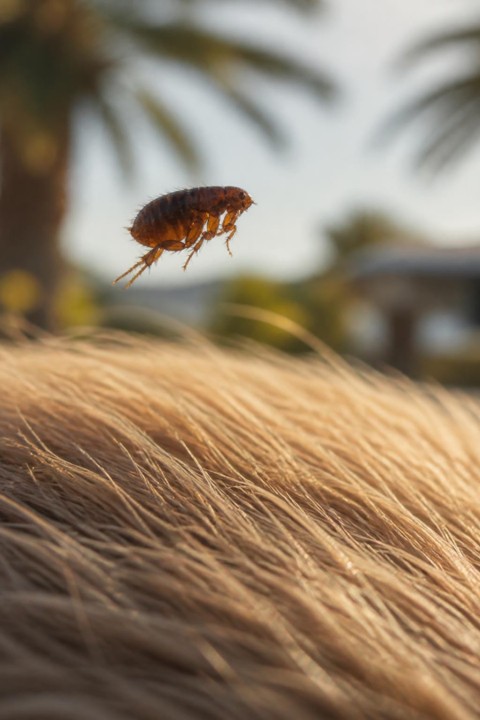
Finding fleas inside your home can quickly turn from a minor annoyance into a frustrating infestation. You may first notice your dog scratching more than usual, small bites around your ankles, or a tiny dark insect jumping across a carpet or piece of furniture. What many homeowners don’t realize is that the fleas they can actually see may represent only part of the problem.
Effective flea control isn’t simply about killing the adult fleas currently jumping around your home. Fleas develop through multiple life stages, and much of that development occurs away from the animal. Eggs can fall into carpets, pet bedding, furniture and other protected areas. Larvae can develop in the environment, while pupae remain protected inside cocoons until conditions encourage adult fleas to emerge.
This is one reason why treating only your dog or cat may not eliminate a flea infestation from your property. Likewise, treating the house while ignoring an infested pet can allow the problem to continue.
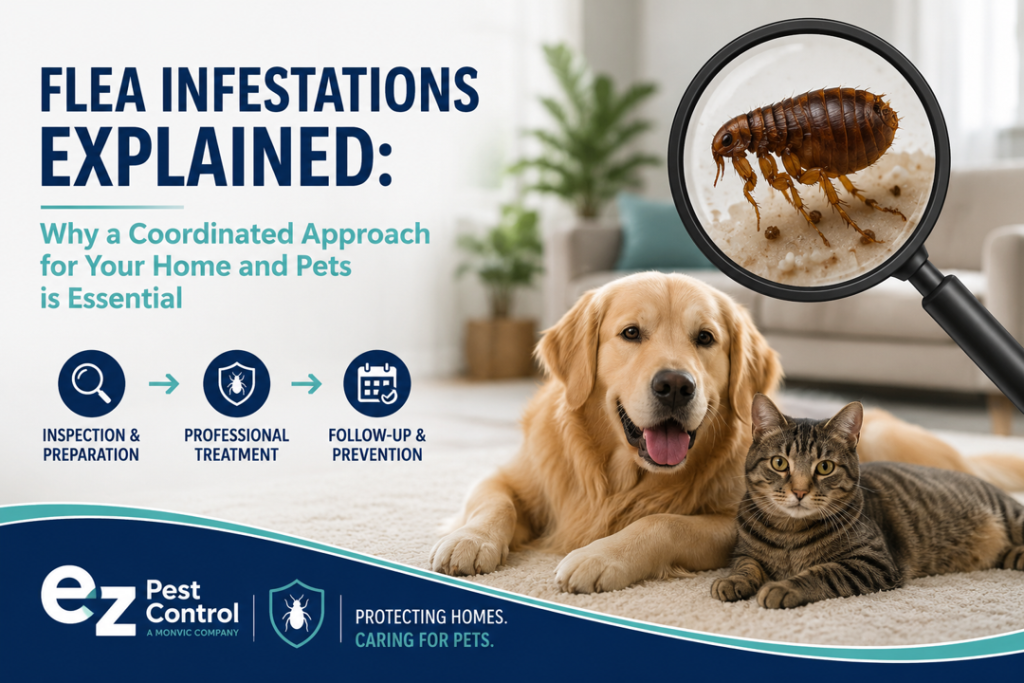
Successful flea control requires a coordinated strategy.
For homeowners in South Florida, that means addressing the infestation through a three-step process that combines inspection and preparation, professional treatment, and follow-up and prevention. At the same time, any pets in the household should receive appropriate flea care under the guidance of a veterinarian.
Understanding how these steps work together can help explain why flea infestations sometimes seem to disappear only to suddenly return days later.
Why Are Fleas So Difficult to Get Rid Of?
Fleas are small, wingless parasites that feed on the blood of animals and, under certain circumstances, people. Although dogs and cats are commonly associated with household flea infestations, fleas may also be associated with wildlife and other animals that enter or spend time around residential properties.
Their ability to reproduce and develop in the surrounding environment is what makes flea control particularly challenging.
An adult female flea can begin producing eggs after feeding. Those eggs don’t necessarily remain attached to the animal. They can fall wherever the pet spends time, including carpets, rugs, sofas, pet beds, cracks and protected areas throughout the home.
The flea then progresses through four basic stages:
Understanding this cycle is fundamental to understanding professional flea control.
Adult fleas are the stage homeowners are most likely to notice. But eggs, larvae and pupae may already be distributed throughout the environment before anyone realizes an infestation exists.
The pupal stage presents a particular challenge. The developing flea is protected inside a cocoon and can be more difficult to reach with conventional control measures. Adults may consequently continue emerging after an initial treatment.
This explains one of the most confusing experiences homeowners have with flea control: seeing fleas after the property has already been treated does not automatically mean that the treatment failed.
Some fleas may simply be emerging from protected pupae that were already present before treatment.
Breaking this cycle requires patience, proper preparation and follow-up.

Why Flea Problems Can Become Serious in South Florida Homes
Fleas can occur throughout the United States, but South Florida provides environmental conditions that can make pest pressure a year-round concern.
The region’s warm climate, humidity, abundant vegetation and active wildlife populations mean homeowners don’t experience the same prolonged cold periods found in many northern states.
Pets also spend considerable time moving between indoor and outdoor environments.
A dog may walk through the yard, visit a park, interact with another animal or simply pass through an area where fleas are present. Wildlife such as rodents, opossums, raccoons and stray animals can also introduce fleas into residential environments.
Once fleas reach a suitable host, the infestation can move indoors.
This is why flea control should not focus exclusively on the visible insects inside the house. A professional inspection considers where the activity is occurring, where pets spend their time and what environmental conditions may be contributing to the infestation.
How Do You Know If You Have a Flea Infestation?
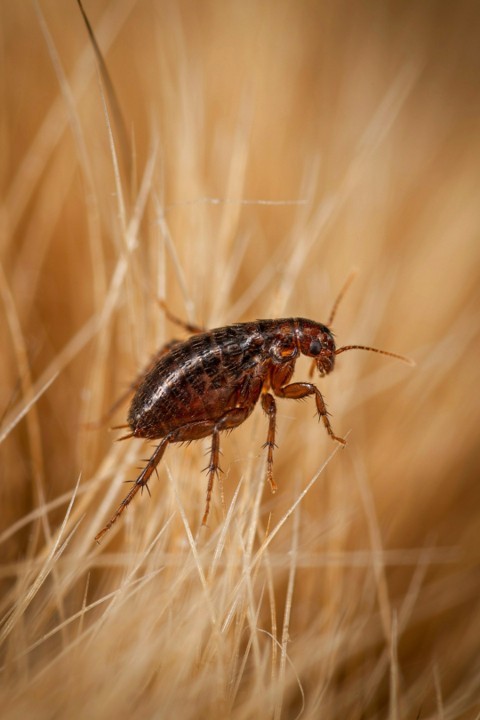
The most obvious sign of fleas is seeing an adult flea. They are small, dark-colored insects known for their ability to jump quickly, which can make them difficult to capture.
But homeowners frequently notice other signs first.
Pets may begin scratching, licking or biting their skin more frequently than normal. You may notice irritated skin, small scabs or areas where your pet has been grooming excessively.
Another common sign is flea dirt.
Flea dirt consists primarily of flea feces containing digested blood and often looks like tiny black or dark reddish specks in an animal’s fur, bedding or resting areas.
Humans can also be bitten. Flea bites commonly appear as small, itchy red spots and are frequently noticed around the feet, ankles and lower legs.
Finding these signs doesn’t necessarily tell you how extensive the infestation has become.
That requires looking beyond the pet.
Carpets, furniture, pet beds and other areas where an animal spends significant amounts of time may contain developing fleas even when adults are not immediately visible.
That is where the first stage of professional flea control begins.
Step 1: Inspection and Preparation
Successful flea treatment begins before any pest control product is applied.
The first objective is to determine where fleas are active and which areas are most likely supporting their development.
A professional flea inspection focuses heavily on areas associated with pets because flea populations are rarely distributed evenly throughout a property.
A dog that spends most of the day sleeping beside a particular sofa, for example, can create a concentrated flea development area around that location. The same may happen around pet beds, rugs, kennels, shaded patios or favorite resting areas.
Inside the home, attention may be given to carpets, upholstered furniture, baseboards, cracks, floor edges and other protected locations.
Outside, the investigation may consider shaded areas, locations where pets rest and places frequented by wildlife or stray animals.
The objective isn’t simply to find adult fleas. It is to understand how the infestation is functioning within the property.
Preparing Your Home for Flea Treatment
Homeowner preparation is an important part of flea control.
One of the most useful things homeowners can do before professional treatment is thoroughly vacuum the areas where fleas may be developing.
Vacuuming helps physically remove flea eggs, larvae, flea dirt and some adult fleas from carpets and other surfaces. The mechanical vibration produced during vacuuming may also encourage some developing fleas to emerge from their pupal cocoons, making them more vulnerable to subsequent control measures.
Particular attention should be given to areas where pets spend time.
Carpets should be vacuumed thoroughly, including along edges and beneath furniture when accessible. Upholstered furniture should also receive attention, especially beneath cushions, along seams and inside crevices.
Pet bedding, blankets, washable rugs and other materials regularly used by pets should be cleaned according to appropriate laundering instructions.
After vacuuming, the collected material should be promptly removed from the home. Vacuum bags or debris should be sealed and placed in an outdoor garbage receptacle so fleas or developing stages are not left inside the house.
Clutter should also be reduced where possible.
Boxes, toys and other objects covering floors can prevent technicians from reaching areas that require inspection or treatment.
Preparation isn’t separate from professional flea control.
It is part of the treatment process itself.
Step 2: Professional Flea Treatment
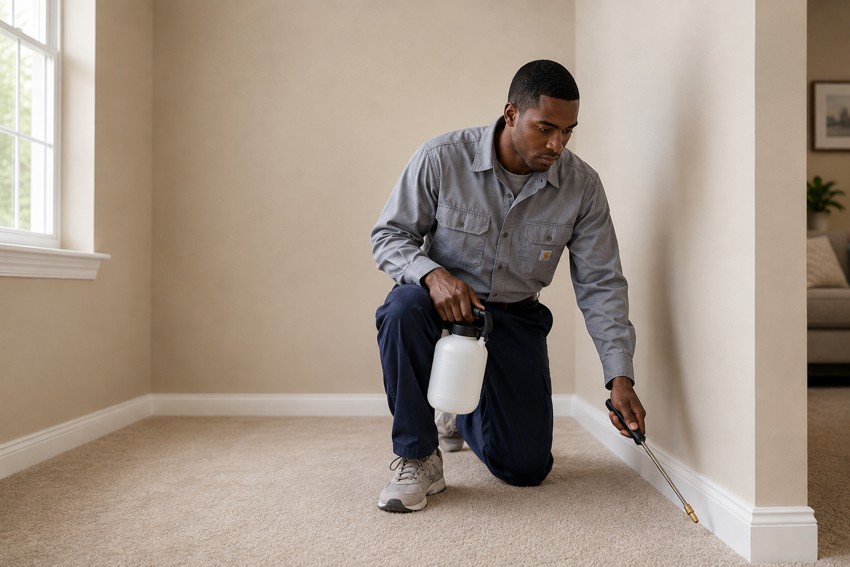
Once the infestation has been evaluated and the property properly prepared, the next step is targeted professional treatment.
This is where flea control differs substantially from simply spraying an insecticide wherever an adult flea has been seen.
A professional treatment strategy considers the flea’s entire life cycle.
Your Pet Must Be Addressed at the Same Time
This point cannot be overstated:
Professional treatment of the property does not replace veterinary flea treatment for your pet.
A pest control professional treats the environment. A veterinarian should guide treatment and prevention for the animal.
If fleas continue living and feeding on an untreated dog or cat, the animal can continue contributing to the infestation even after the home has been professionally treated.
Conversely, treating only the animal can leave eggs, larvae and pupae developing throughout the home.
The two approaches need to work together.
All pets in the household should be considered, not simply the animal showing the most obvious symptoms.
Never assume that a flea treatment formulated for one species is automatically appropriate for another. Pet flea-control products have specific directions, dosages, age requirements and species restrictions.
Your veterinarian can recommend an appropriate treatment and prevention program based on the animal’s species, age, weight, health and lifestyle.

Step 3: Follow-Up and Prevention
Professional flea control doesn’t necessarily end when the technician completes the initial application.
In fact, the days following treatment can be extremely important.
Because flea pupae are protected inside their cocoons, some adults may continue emerging after the initial service.
Homeowners sometimes interpret this as evidence that the treatment didn’t work and immediately begin applying additional over-the-counter products.
That can be counterproductive.
Instead, follow the instructions provided by your pest control professional and understand that flea control is a process rather than an instant event.
Why You May Still See Fleas After Treatment
Imagine that dozens of flea pupae were already hidden throughout a carpet before treatment occurred.
The treatment can address exposed stages and establish control in the environment, but fleas protected inside cocoons may survive until they emerge.
Once adults emerge and come into contact with treated areas, the control process continues.
For this reason, continued flea activity during the initial period after treatment does not automatically indicate reinfestation or treatment failure.
The important question is whether activity is progressively decreasing.
Moderate or severe flea infestations can require time to fully resolve because the treatment must work through the existing population as different stages develop and emerge.
Keep Vacuuming
Vacuuming remains valuable after professional treatment when performed according to the technician’s instructions.
Regular vacuuming helps remove developing stages and adult fleas while creating physical disturbance that can encourage pupae to emerge.
Concentrate on the same high-risk areas identified earlier:
carpets, rugs, pet resting areas, upholstered furniture, beneath furniture and along floor edges.
Continue disposing of vacuum contents outside the home.
However, homeowners should avoid immediately steam cleaning, shampooing carpets, mopping treated surfaces or performing other intensive cleaning procedures unless instructed to do so by their pest control professional.
These activities may interfere with residual treatments before they have had sufficient time to work.
Follow-Up Treatment May Be Necessary
The flea life cycle is precisely why follow-up is so important.
A professional may recommend additional service depending on the severity of the infestation, environmental conditions and flea activity following the initial treatment.
The purpose isn’t simply to repeat the first application.
Follow-up allows the technician to evaluate whether flea activity is declining, determine whether previously protected stages have emerged and identify any remaining hotspots or sources of reinfestation.
This is particularly important when the original infestation was extensive.
Treating the Pet, Home and Environment as One Problem
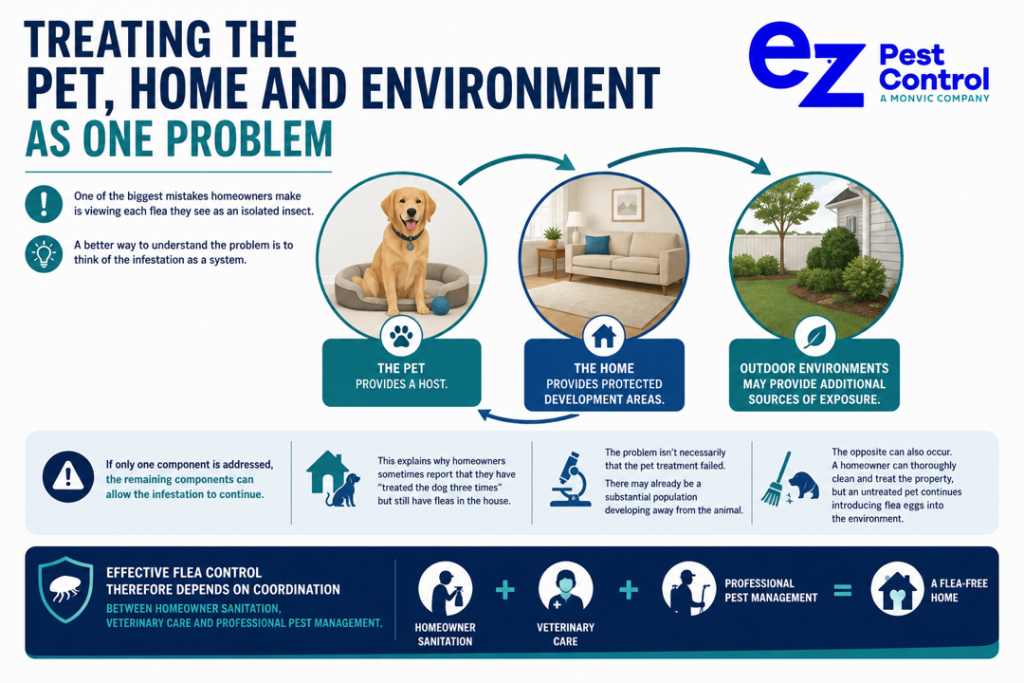
One of the biggest mistakes homeowners make is viewing each flea they see as an isolated insect.
A better way to understand the problem is to think of the infestation as a system.
The pet provides a host.
The home provides protected development areas.
Outdoor environments may provide additional sources of exposure.
If only one component is addressed, the remaining components can allow the infestation to continue.
This explains why homeowners sometimes report that they have “treated the dog three times” but still have fleas in the house.
The problem isn’t necessarily that the pet treatment failed.
There may already be a substantial population developing away from the animal.
The opposite can also occur. A homeowner can thoroughly clean and treat the property, but an untreated pet continues introducing flea eggs into the environment.
Effective flea control therefore depends on coordination between homeowner sanitation, veterinary care and professional pest management.
Common Flea Control Mistakes That Can Keep an Infestation Going
Perhaps the most common mistake is waiting too long.
Because fleas reproduce quickly, a problem that initially seems limited to one pet can become established throughout its resting areas before the homeowner realizes what is happening.
Another mistake is treating only visible adults.
Killing the fleas you see may provide immediate satisfaction, but it doesn’t necessarily address the developing population hidden throughout the property.
Homeowners also frequently overlook furniture.
People naturally associate fleas with carpeting, but pet beds, sofas, chairs and other upholstered surfaces can also harbor developing stages.
Outdoor sources are another commonly overlooked factor.
Repeated flea infestations may sometimes be associated with wildlife, stray animals or flea activity around locations where pets spend time outdoors.
Finally, one of the most important mistakes to avoid is randomly combining pest-control products.
Applying more pesticide does not automatically produce better flea control.
Professional pest management relies on selecting appropriate products, applying them to appropriate locations and following label directions.
Can You Get Rid of Fleas Without Treating the Yard?
Sometimes.
Not every indoor flea infestation requires broad outdoor treatment.
The decision should depend on the source of the infestation and the conditions around the property.
If a pet acquired fleas elsewhere and the infestation is primarily developing indoors, the treatment strategy may focus heavily on the interior environment and veterinary care.
But if fleas are associated with outdoor pet resting areas, shaded sections of the property, wildlife activity or recurring exposure around the home, outdoor management may become important.
This is another reason inspection comes before treatment.
Professional flea control should be based on where the problem exists, rather than automatically applying the same treatment to every home.
Can Fleas Live in a Home Without Pets?
Yes.
Although adult fleas depend on blood meals, a flea infestation can remain noticeable even after a pet has been removed from the property.
Eggs, larvae and particularly pupae may already be present in carpets and protected areas.
This is why homeowners moving into a previously occupied property can sometimes experience what appears to be a sudden flea infestation despite not owning pets.
Activity inside a previously quiet property can stimulate adult fleas to emerge from their cocoons.
People entering rooms, walking across floors and creating vibrations can contribute to this emergence.
A vacant property with a previous flea problem should therefore not automatically be assumed flea-free simply because no animals are currently living there.
How Long Does It Take to Get Rid of Fleas?
There is no universal timeline.
A small infestation identified early may be resolved much more quickly than a heavy infestation that has been developing unnoticed throughout several rooms.
The number of pets, extent of carpeting, environmental conditions, wildlife activity, homeowner preparation and consistency of veterinary flea prevention can all influence the outcome.
Most importantly, flea development doesn’t stop simply because the first treatment has occurred.
Existing pupae may continue producing adults for some time.
For moderate or severe infestations, complete control may require repeated sanitation, continued monitoring and professional follow-up.
Homeowners should therefore judge progress by the overall reduction in flea activity, rather than expecting every flea to disappear immediately after one service.
How to Prevent Fleas From Coming Back
Once an infestation has been controlled, prevention becomes much easier than starting the elimination process again.
Consistent veterinary flea prevention for pets is one of the most important defenses.
Pet bedding should be cleaned regularly, and areas where pets spend considerable time should be vacuumed as part of normal household maintenance.
Yards should also be maintained to reduce unnecessarily favorable flea environments.
Grass and vegetation should be kept under control, debris should not be allowed to accumulate around pet areas, and recurring wildlife activity should be investigated when it appears to be contributing to pest problems.
Pet owners should also pay attention after boarding their animals, visiting dog parks, traveling or introducing another animal into the household.
Early detection can prevent a few fleas from becoming an established indoor population.
When Should You Call a Professional Flea Exterminator?
Seeing an occasional flea doesn’t always mean your entire home has a severe infestation.
But repeated flea sightings, persistent bites, excessive pet scratching or continued flea activity despite cleaning and veterinary treatment can indicate that the infestation has become established in the environment.
Professional assistance becomes particularly valuable when fleas are appearing throughout multiple rooms, the problem repeatedly returns, several pets are involved, or the source of the infestation is unclear.
A trained pest management professional can inspect the property, identify likely hotspots and determine whether indoor treatment, outdoor treatment or a combination of approaches is appropriate.
More importantly, professional flea control can target the infestation as a life-cycle problem, rather than simply reacting to the adult fleas currently visible.
Professional Flea Control in South Florida
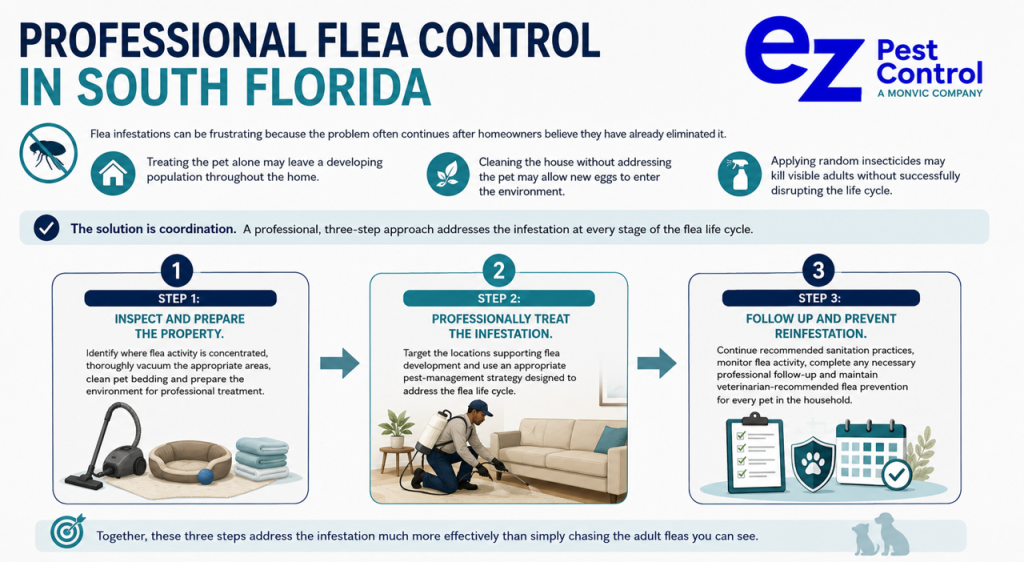
Flea infestations can be frustrating because the problem often continues after homeowners believe they have already eliminated it.
Treating the pet alone may leave a developing population throughout the home. Cleaning the house without addressing the pet may allow new eggs to enter the environment. Applying random insecticides may kill visible adults without successfully disrupting the life cycle.
The solution is coordination.
Step 1: Inspect and prepare the property.
Identify where flea activity is concentrated, thoroughly vacuum the appropriate areas, clean pet bedding and prepare the environment for professional treatment.
Step 2: Professionally treat the infestation.
Target the locations supporting flea development and use an appropriate pest-management strategy designed to address the flea life cycle.
Step 3: Follow up and prevent reinfestation.
Continue recommended sanitation practices, monitor flea activity, complete any necessary professional follow-up and maintain veterinarian-recommended flea prevention for every pet in the household.
Together, these three steps address the infestation much more effectively than simply chasing the adult fleas you can see.
Need Help Getting Rid of Fleas? Contact EZ Pest Control
If fleas keep appearing in your home despite vacuuming, cleaning and treating your pets, the problem may already extend beyond the fleas you can see.
EZ Pest Control provides professional flea control services for homes in South Florida, helping homeowners identify flea activity, locate problem areas and develop an appropriate treatment strategy based on the conditions of the property.
Our approach focuses on more than simply eliminating visible adult fleas. By evaluating the areas where fleas are developing and addressing the environmental side of the infestation, professional treatment can help disrupt the flea life cycle and reduce the likelihood of recurring problems.
Pet owners should simultaneously work with their veterinarian to ensure every animal in the household receives appropriate flea treatment and ongoing prevention.
If you’re dealing with persistent fleas in your home, don’t wait for a small problem to become a larger infestation.
Contact EZ Pest Control to schedule a professional flea inspection and take the first step toward getting your South Florida home comfortable and flea-free again.

Frequently Asked Questions About Flea Control
The three-step flea control process includes inspection and preparation, professional treatment, and follow-up and prevention. The goal is to identify flea hotspots, treat the areas where fleas are developing, and continue monitoring and sanitation until the life cycle has been disrupted.
Fleas may continue appearing after treatment because pupae can remain protected inside cocoons and emerge later as adults. Seeing some fleas after the first treatment does not automatically mean the treatment failed. Follow-up, vacuuming, and continued monitoring are often necessary.
Yes. Treating only the pet may leave eggs, larvae, and pupae developing inside the home, while treating only the property may allow fleas to remain on an untreated animal. The property should be professionally managed while pets receive appropriate flea care from a veterinarian.
Preparation usually includes thoroughly vacuuming carpets, rugs, furniture, floor edges, and pet resting areas, washing pet bedding and other washable materials, reducing clutter, and disposing of vacuum contents outside the home. Always follow the specific preparation instructions provided by your pest control professional.
The timeline depends on the severity of the infestation, the number of pets, environmental conditions, and how consistently the treatment and follow-up recommendations are completed. Moderate or severe infestations can take several weeks or longer because fleas continue emerging from protected life stages.
Yes, when recommended by your technician. Vacuuming can help remove flea eggs, larvae, and adults and may encourage pupae to emerge from their cocoons. However, avoid steam cleaning, shampooing carpets, or aggressively cleaning treated surfaces unless your pest control professional says it is appropriate.
No. Fleas and their developing stages can also be found in pet bedding, upholstered furniture, cracks, floor edges, rugs, underneath furniture, and other protected areas where pets spend time.
Yes. Flea eggs, larvae, and especially pupae may remain inside a property even after a pet is no longer present. Activity and vibrations inside the home can later stimulate adult fleas to emerge from their cocoons.
Not always. Outdoor treatment should depend on the source of the infestation and the conditions around the property. If pets, wildlife, shaded resting areas, or recurring outdoor exposure are contributing to the problem, targeted outdoor flea control may be recommended.
You should consider professional flea control when flea activity persists despite cleaning and veterinary treatment, when bites or sightings are occurring in multiple rooms, when several pets are involved, or when the source of the infestation is difficult to identify.
No. EZ Pest Control focuses on treating the property and the environmental side of the flea infestation. Pet treatment should be handled under the guidance of a veterinarian. Coordinating both approaches is important for successful flea control.