
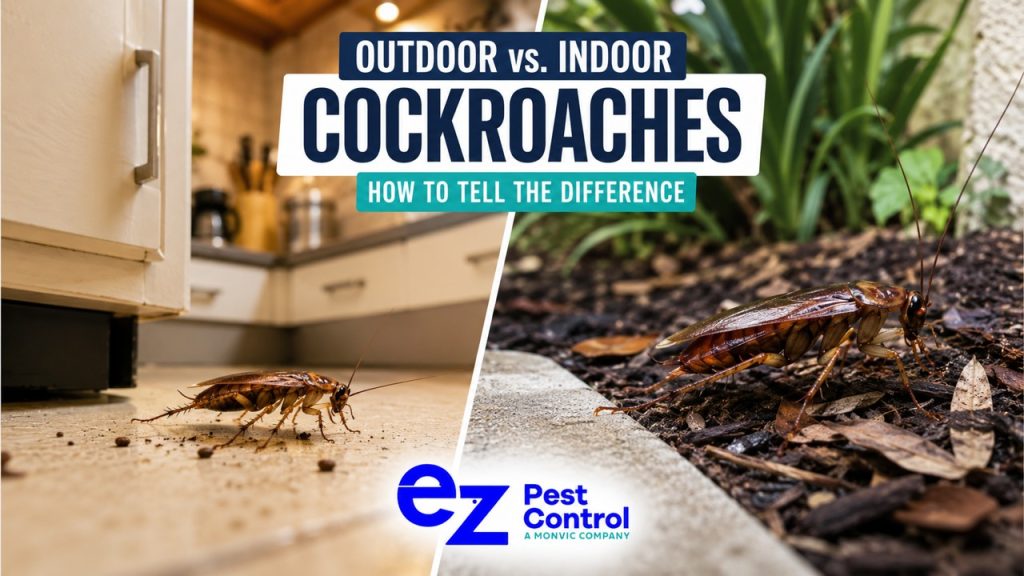
Outdoor vs. Indoor Cockroaches in South Florida: How to Tell the Difference
Seeing a cockroach inside your South Florida home usually triggers the same reaction: Where did it come from, and are there more hiding somewhere?
The answer isn’t always as simple as it seems.
Some cockroach species are highly adapted to living and reproducing inside buildings. Once established, they can hide behind appliances, inside cabinets, around plumbing and in other protected spaces where food, moisture and warmth are available.
Other cockroaches are primarily outdoor pests. They normally live around landscaping, trees, mulch, leaf litter, drains, sewers and other exterior environments but occasionally find their way inside homes.
That distinction is extremely important.
Finding a German cockroach in your kitchen can mean something very different from finding a large American or smokybrown cockroach that entered through a door, plumbing opening or another exterior access point.
And in South Florida, where warm temperatures, humidity, vegetation and abundant outdoor habitats support numerous cockroach species, understanding the difference between indoor and outdoor cockroaches can help determine the right approach to control.
Are All Cockroaches Found Inside Your Home Indoor Cockroaches?
Discovering termites in your home can be overwhelming.
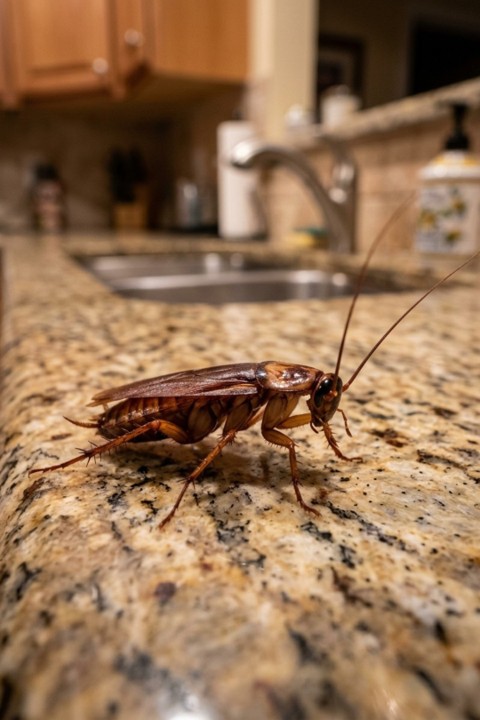
No. One of the biggest misconceptions about cockroaches is that finding one indoors automatically means it lives there.
Cockroaches can generally be divided into species that readily establish populations inside buildings and species that primarily live outdoors or around structures.
Indoor Species
Indoor species are particularly concerning because they can complete their life cycle inside the home. Food, water, warmth and protected hiding places allow populations to grow without the insects needing to return outdoors.
Outdoor Species
Outdoor cockroaches behave differently. They may enter through doors, windows, cracks, utility penetrations, drains and other openings, but the conditions supporting the population may actually be outside the structure.
This means that successful cockroach control starts with a fundamental question:
Is the cockroach living inside the house, or is it coming inside from somewhere else?
Without answering that question, homeowners can spend considerable time spraying visible cockroaches without addressing the actual source of the problem.
Indoor Cockroaches: When the Infestation Is Inside the Home
Indoor cockroaches are species capable of establishing and maintaining populations within buildings.
Among the most important examples is the German cockroach.
German cockroaches are relatively small compared with many of the large cockroaches commonly seen outdoors in Florida. Adults are typically light brown to tan and have two dark parallel stripes behind the head.
But their size shouldn’t be mistaken for a minor pest problem.
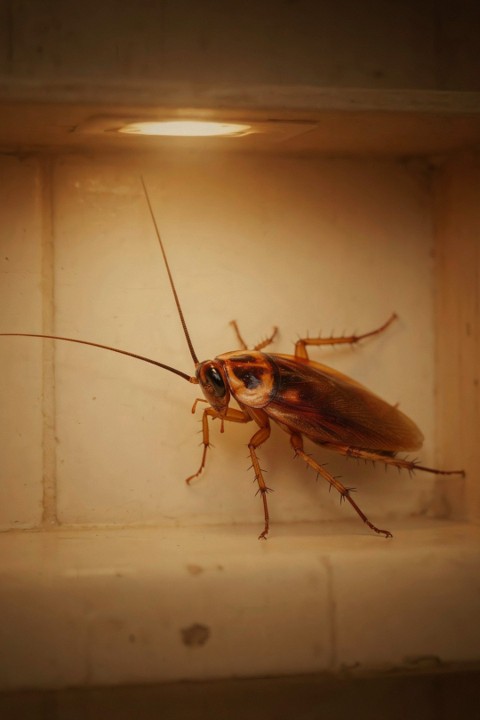
German cockroaches are particularly well adapted to indoor environments and can reproduce rapidly when food, moisture and shelter are available.
Kitchens are among their preferred environments.
Cabinets, drawers, appliances, cracks, plumbing areas and spaces around refrigerators, dishwashers and stoves can provide the protected conditions they need.
Bathrooms and other moisture-producing areas may also support activity.
Unlike a large outdoor cockroach that accidentally enters through an open door, repeated German cockroach sightings can indicate that the insects are living and reproducing inside the structure.
Why German Cockroaches Can Be So Difficult to Control
German cockroaches don’t need large spaces to survive.
Small cracks, gaps around cabinetry, appliance components and other protected areas can provide suitable harborages.
Their proximity to food and moisture also allows populations to remain concentrated in relatively small areas.
This is why simply spraying the cockroaches you see usually doesn’t solve the underlying problem.
The visible insects may represent only a portion of the population.
Others may remain hidden in harborages during much of the day and emerge when conditions are favorable.
A professional inspection therefore focuses on identifying these activity zones rather than simply treating open floor areas.
Monitoring devices may also help determine where activity is concentrated and whether control measures are reducing the population.
Brown-Banded Cockroaches: Another Indoor Species
German cockroaches aren’t the only species capable of establishing indoor populations.
The brown-banded cockroach can also live and reproduce inside buildings.
Brown-banded cockroaches are small and get their name from the lighter bands visible across their bodies and wings.
Their behavior differs somewhat from German cockroaches.
While German cockroaches are strongly associated with kitchens, bathrooms and moisture, brown-banded cockroaches can occupy comparatively drier areas and may be found higher within rooms.
They can occur around furniture, cabinets, shelving, closets and electronic equipment.
This difference demonstrates why species identification matters.
Two relatively small cockroach species found indoors may require technicians to investigate different parts of the property.
American Cockroaches
The American cockroach is one of the largest cockroach species homeowners may encounter.
Adults are reddish-brown and typically have a lighter yellowish marking around the area behind the head.
Despite the name, American cockroaches are not limited to outdoor environments.
They can survive around structures and may occupy warm, dark and humid environments such as sewer systems, drains, utility areas and other protected locations. Under favorable conditions, they may also become established within structures.
This makes context particularly important.
A single large cockroach entering from outdoors is different from repeated activity associated with drains, utility spaces or another persistent source.
Professional identification and inspection help determine which situation is occurring.
Smokybrown Cockroaches
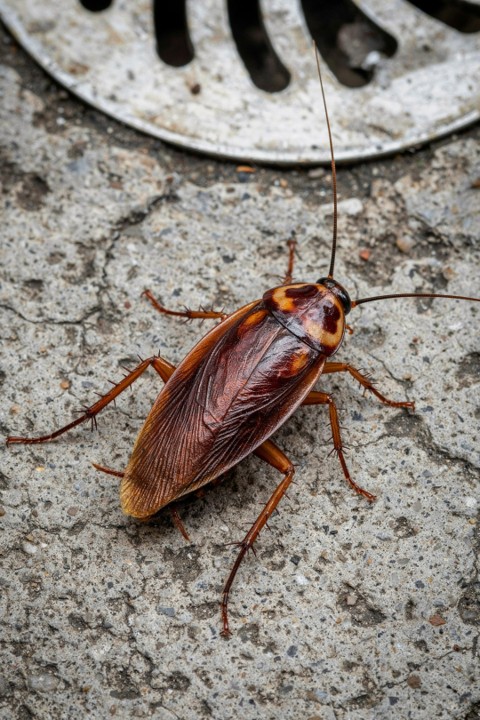
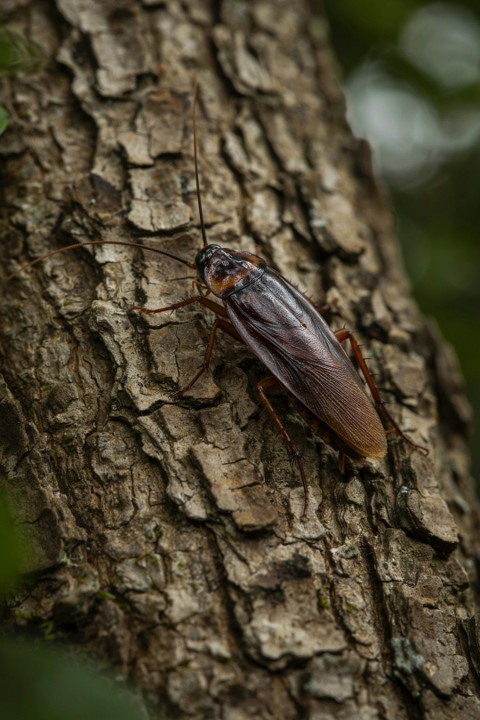
The smokybrown cockroach is another large species that South Florida residents may encounter.
Adults have a relatively uniform dark brown or mahogany appearance and are capable flyers.
They are strongly associated with outdoor environments and can be found around trees, vegetation, mulch and other humid protected locations.
Because they can fly and may be attracted to lights, smokybrown cockroaches can enter homes through windows, doors and other openings.
For homeowners, this can create the impression that an indoor infestation has suddenly appeared.
But if the population is actually developing outside, repeatedly spraying the interior won’t address the primary source.
Exterior habitat, entry points and environmental conditions become much more important.
Australian Cockroaches
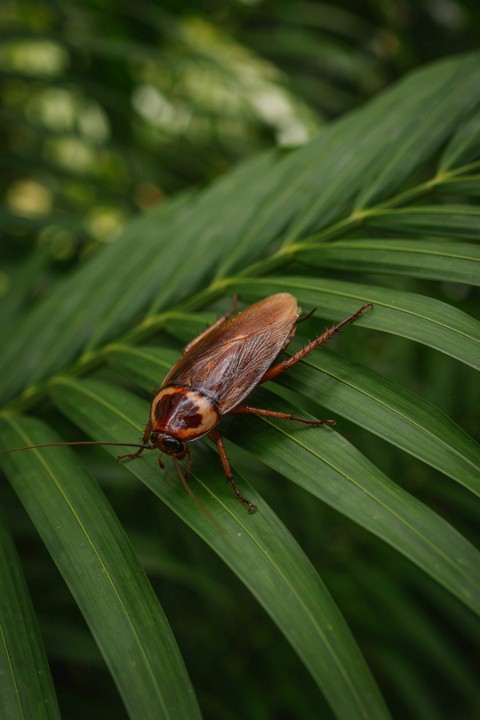
The Australian cockroach is another outdoor species encountered in warm climates.
It can resemble the American cockroach but generally has distinctive lighter markings along portions of the wings.
Australian cockroaches are commonly associated with vegetation and outdoor environments.
Landscaping around a home can therefore become relevant when this species is repeatedly appearing near the structure.
Again, identification matters.
Two large cockroaches may look similar to a homeowner but originate from different environments and require different management considerations.
Florida Woods Cockroaches
The Florida woods cockroach is especially relevant when discussing cockroaches in Florida.
This large, dark species is primarily associated with outdoor environments and is commonly found around decaying vegetation, leaf litter, wood and other protected habitats.
It is not generally considered the same type of indoor structural pest as the German cockroach.
Occasional individuals may still enter homes.
Finding one indoors can certainly be unpleasant, but the appropriate response may involve examining exterior conditions and access points rather than assuming that hundreds are reproducing behind the kitchen cabinets.
What Is a Palmetto Bug?
If you live in Florida, you’ve probably heard someone refer to a large cockroach as a “palmetto bug.”
The term can be confusing because a palmetto bug isn’t one specific species.
It is a common informal name used for several large cockroaches found in Florida and other parts of the southeastern United States.
Depending on who is using the term, “palmetto bug” may refer to American cockroaches, smokybrown cockroaches, Australian cockroaches or Florida woods cockroaches.
That is why telling a pest control professional that you saw a “palmetto bug” provides useful context but doesn’t necessarily identify the pest.
The actual species matters.
A professional inspection can help determine what kind of cockroach is present and whether the source is primarily indoors or outdoors.
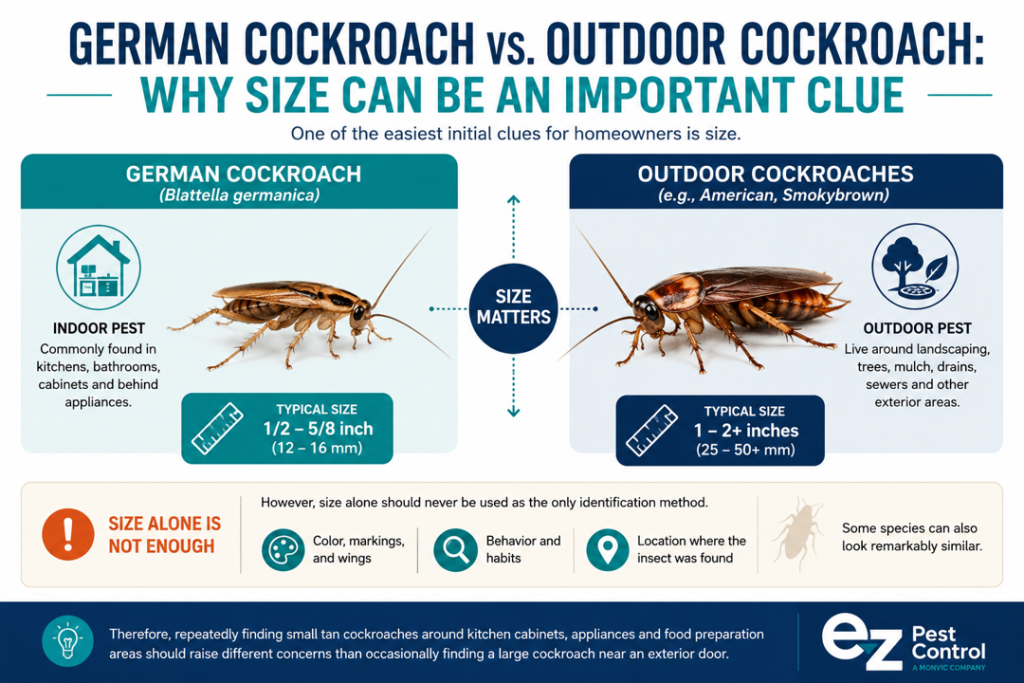
German Cockroach vs. Outdoor Cockroach: Why Size Can Be an Important Clue
One of the easiest initial clues for homeowners is size.
German cockroaches are relatively small.
Many of the outdoor cockroaches commonly encountered in South Florida are considerably larger.
Therefore, repeatedly finding small tan cockroaches around kitchen cabinets, appliances and food preparation areas should raise different concerns than occasionally finding a large cockroach near an exterior door.
However, size alone should never be used as the only identification method.
Color, markings, wings, behavior and the location where the insect was found can all provide additional clues.
Some species can also look remarkably similar.
German Cockroach vs. Asian Cockroach: A Good Example of Why Identification Matters
The difference between German and Asian cockroaches demonstrates why visual identification can sometimes be difficult.
The two can look very similar.
But their behavior and preferred habitats are very different.
German cockroaches are strongly associated with indoor environments and can establish serious infestations inside homes.
Asian cockroaches are primarily outdoor insects.
They are also strong flyers and may be attracted to lights, which can bring them toward houses and sometimes indoors.
A homeowner who sees a small cockroach may immediately assume it is German.
But if the insect flew toward a light from an outdoor area, the situation may require a different assessment.
Professional identification considers not only what the cockroach looks like, but also where it was found and how it behaves.
Indoor vs. Outdoor Cockroaches: Why the Difference Changes the Treatment
If cockroaches are reproducing inside the home
the control strategy needs to target their indoor harborages and resources.
If the cockroaches are primarily coming from outdoors
treating interior rooms alone may produce disappointing results because the source remains untouched.
The treatment strategy should follow the biology of the species.
This is where identification becomes more than an academic exercise.
Controlling Indoor Cockroach Infestations
Indoor cockroach control usually requires an integrated approach.
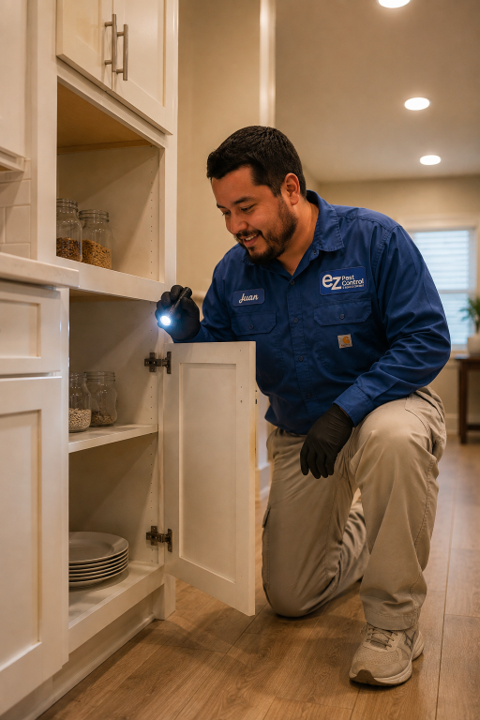
The first step is inspection.
Technicians need to identify where cockroaches are hiding, feeding and obtaining moisture.
In a German cockroach infestation, this often means carefully evaluating kitchens and other areas around appliances, cabinets, plumbing and food storage.
Sanitation is also critical.
Food crumbs, grease residues, pet food and accessible garbage can provide cockroaches with resources that allow populations to persist.
Water matters just as much.
Leaks, condensation and standing moisture can support cockroach activity.
Professional treatments can then be directed toward the areas where cockroaches actually live and travel.
Depending on the infestation and professional assessment, management may involve baits, targeted applications, monitoring and other integrated pest management techniques.
The objective is not to cover every surface with pesticide.
It is to remove resources, identify harborages and strategically target the population.
Controlling Outdoor Cockroaches
Outdoor cockroach management requires a different emphasis.
If cockroaches are living in landscaping or other exterior environments and entering the house, reducing entry and modifying favorable habitat can be extremely important.
Homeowners should inspect gaps around doors and windows.
Door sweeps can help reduce openings beneath exterior doors.
Cracks and penetrations around plumbing, utilities and other structural openings may need to be sealed.
Screens should be kept in good condition.
Vegetation and mulch immediately adjacent to the structure may also deserve attention when they provide protected cockroach habitat.
Leaf litter, debris and accumulated organic material can create additional hiding areas.
Moisture should also be evaluated.
Drainage problems, leaking outdoor fixtures and persistently damp locations can make certain areas more favorable to cockroaches.
Outdoor lighting can be another factor for species attracted to light.
The goal is to make the structure more difficult to enter and the immediate exterior environment less favorable for cockroach activity.
Why South Florida Homes Experience So Much Outdoor Cockroach Pressure
South Florida offers many conditions cockroaches can exploit.
Warm temperatures allow insect activity during much of the year.
Humidity and rainfall can create moist environments.
Tropical and subtropical landscaping provides abundant shelter and organic material.
Homes may also be surrounded by palms, dense vegetation, mulch, drainage systems, patios and other areas that provide suitable habitat.
This doesn’t mean homeowners should remove all landscaping.
It means the relationship between landscaping and the structure should be considered when cockroaches repeatedly appear indoors.
A beautifully landscaped property can still be managed to reduce pest pressure through maintenance, moisture management, exclusion and targeted professional pest control.

Why Cockroaches May Appear After Heavy Rain
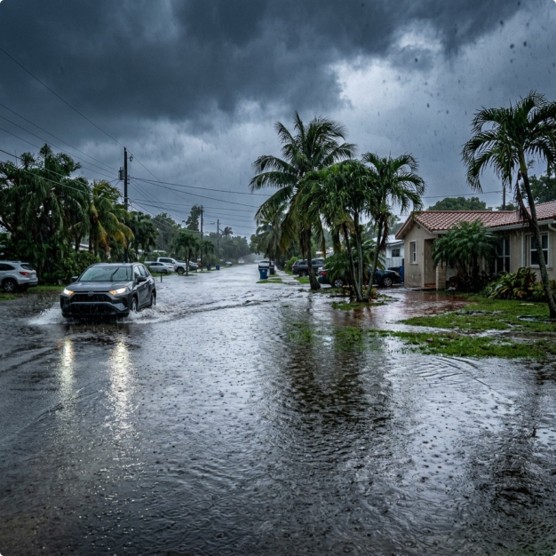
South Florida residents sometimes notice increased cockroach activity around periods of heavy rain.
Excess water can disturb outdoor harborages and change the conditions in drains, sewer systems, landscaping and other environments.
Cockroaches seeking more suitable shelter may move toward structures.
Doors, garages, utility openings and other access points can then become entry routes.
This is another example of why a sudden large cockroach inside the home doesn’t automatically mean an indoor population suddenly developed.
Environmental conditions outside may have temporarily increased pest movement.
Repeated activity, however, deserves investigation.
Does Seeing One Cockroach Mean You Have an Infestation?
Not necessarily.
The significance of a single cockroach depends heavily on the species and circumstances.
One outdoor cockroach found near an open patio door is very different from one German cockroach found beside a refrigerator.
A large outdoor species may simply have wandered or flown inside.
A German cockroach found in an area with food, water and shelter can be considerably more concerning because the species is strongly adapted to indoor reproduction.
Frequency also matters.
Occasional sightings associated with weather or open doors suggest something different from repeated sightings in the same areas night after night.
Other evidence can also indicate an established population, including droppings, egg cases, shed skins and cockroaches of different developmental stages.
Seeing nymphs can be particularly informative because it may suggest reproduction is occurring nearby.
Rather than asking only “How many cockroaches have I seen?”, it is often more useful to ask:
“What species am I seeing, where am I seeing them, and how often?”
Why Spraying Every Cockroach You See Isn’t Enough
Aerosol sprays may kill a cockroach that is directly contacted, but eliminating an individual insect is not the same as controlling the source.
If German cockroaches are reproducing behind appliances and cabinets, spraying one insect crossing the counter does little to address the hidden population.
If smokybrown cockroaches are entering from landscaping outside, spraying the bathroom every time one appears doesn’t address the exterior habitat or entry route.
Overuse or inappropriate use of sprays can also interfere with a more strategic pest management program.
Effective cockroach control relies on identification, inspection, sanitation, exclusion, monitoring and appropriate targeted treatment.
The question shouldn’t simply be:
“What can I spray?”
The better question is:
“Why are these cockroaches here?”
How to Help Prevent Indoor Cockroach Infestations
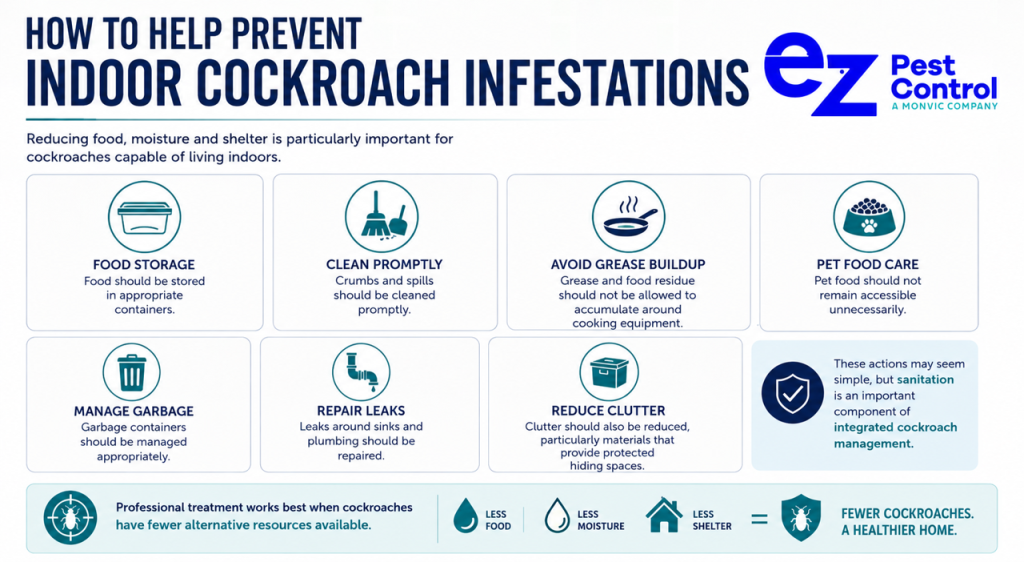
Reducing food, moisture and shelter is particularly important for cockroaches capable of living indoors.
Food should be stored in appropriate containers.
Crumbs and spills should be cleaned promptly.
Grease and food residue should not be allowed to accumulate around cooking equipment.
Pet food should not remain accessible unnecessarily.
Garbage containers should be managed appropriately.
Leaks around sinks and plumbing should be repaired.
Clutter should also be reduced, particularly materials that provide protected hiding spaces.
These actions may seem simple, but sanitation is an important component of integrated cockroach management.
Professional treatment works best when cockroaches have fewer alternative resources available.
How to Help Keep Outdoor Cockroaches Outside
Preventing outdoor cockroaches from entering requires looking at the home from the outside inward.
Inspect doors, windows and screens for openings.
Check utility penetrations and other structural gaps.
Reduce excessive debris and organic material immediately around the structure.
Address persistent moisture.
Maintain vegetation appropriately around the building.
Consider whether exterior lighting is contributing to insect activity around entrances.
Garages deserve special attention because garage doors frequently provide gaps through which large cockroaches can enter.
The objective is not to create an insect-free outdoor environment.
South Florida’s climate and ecosystem make that unrealistic.
The goal is to reduce cockroach pressure around the structure and make it harder for outdoor species to enter the home.
When Should You Call a Professional Cockroach Exterminator?
Professional help is appropriate when cockroaches are repeatedly appearing inside, when small cockroaches are being found around kitchens or bathrooms, when multiple developmental stages are visible, or when the source of the activity isn’t clear.
Recurring large cockroaches can also justify professional inspection.
Even if the species is primarily outdoor, repeated entry may indicate favorable habitat, moisture issues or structural access points that need to be identified.
A pest management professional can determine which species is present and evaluate whether the problem originates inside the structure, outside the structure or from a combination of both.
That diagnosis is what allows the treatment strategy to match the actual pest problem.
Professional Cockroach Control in South Florida
Cockroach control isn’t a one-size-fits-all service.
A German cockroach infestation developing behind kitchen appliances should not be approached the same way as smokybrown cockroaches entering from landscaping.
An American cockroach associated with a drain or utility environment may require another approach.
And a Florida woods cockroach that wandered inside doesn’t necessarily indicate an indoor breeding population at all.
The first step is correct identification.
The second is determining where the cockroaches are actually living and reproducing.
From there, an integrated strategy can address sanitation, moisture, entry points, exterior conditions and targeted professional treatments as appropriate.
Indoor or Outdoor Cockroaches? Let EZ Pest Control Identify the Source
If you’re repeatedly seeing cockroaches inside your South Florida home, don’t assume every species requires the same treatment.
EZ Pest Control can inspect your property, identify the type of cockroach you’re dealing with and determine whether the activity is primarily originating inside or outside the structure.
For indoor infestations
the focus may include identifying harborages, reducing conditions that support the population and applying targeted professional control.
For outdoor cockroach pressure
the strategy may focus more heavily on exterior conditions, entry points and the areas around the structure that are contributing to recurring activity.
The difference matters.
Treating the wrong area can leave the real source of the infestation untouched.
Contact EZ Pest Control for a professional cockroach inspection and a treatment strategy based on the species, the property and the actual source of the problem.
Learn the difference between indoor and outdoor cockroaches in South Florida, how to identify common species, and when professional pest control is needed.
Frequently Asked Questions About Indoor and Outdoor Cockroaches
Indoor cockroaches are species that can live and reproduce inside buildings, while outdoor cockroaches primarily live outside and may enter homes temporarily. German and brown-banded cockroaches are common indoor species, while American, smokybrown, Australian, and Florida woods cockroaches are more commonly associated with outdoor or peridomestic environments.
Not necessarily. A single large outdoor cockroach may have entered through a door, window, drain, or another opening. However, finding a German cockroach in a kitchen or bathroom can be more concerning because this species commonly lives and reproduces indoors.
German cockroaches are among the most important indoor cockroach pests. Brown-banded cockroaches can also establish indoor populations. German cockroaches are commonly associated with kitchens, bathrooms, appliances, cabinets, and other areas where food, warmth, moisture, and shelter are available.
Common outdoor or peridomestic species in Florida include American cockroaches, smokybrown cockroaches, Australian cockroaches, and Florida woods cockroaches. These species may live around landscaping, trees, mulch, leaf litter, drains, sewers, and other humid or protected outdoor areas.
Yes. “Palmetto bug” is an informal name commonly used in Florida for several large cockroach species. It may refer to American, smokybrown, Australian, Florida woods, or other large outdoor cockroaches. It is not the scientific name of one specific species.
German cockroaches are relatively small, usually light brown or tan, and have two dark parallel stripes behind the head. They are commonly found in kitchens and bathrooms and usually run rather than fly. Many outdoor cockroaches are larger and may be found near doors, garages, landscaping, drains, or exterior lights.
Some large cockroach species can survive around or within structures under favorable conditions, but many primarily originate outdoors. Repeated sightings should be investigated because activity may be connected to drains, sewers, moisture, landscaping, attics, crawl spaces, or structural entry points.
Heavy rain can disturb outdoor cockroach habitats and change conditions in landscaping, drains, sewers, and other protected areas. Cockroaches may then move toward buildings in search of shelter, making temporary indoor sightings more common.
Different cockroach species live, hide, and reproduce in different environments. Indoor infestations may require targeted treatment of harborages, sanitation, baiting, and monitoring, while outdoor cockroach problems may require greater emphasis on exclusion, moisture reduction, landscaping, entry points, and exterior control.
Sprays alone usually do not provide long-term cockroach control. Effective management often combines inspection, sanitation, exclusion, monitoring, and targeted treatments based on the species and where the cockroaches are living.
Seal cracks and gaps, repair screens, install or maintain door sweeps, reduce moisture, remove excessive leaf litter and debris near the structure, manage vegetation, and inspect openings around plumbing and utility lines. Outdoor lighting near entryways can also influence some flying cockroach species.
Professional help is recommended when cockroaches appear repeatedly, when small roaches are found around kitchens or bathrooms, when nymphs or egg cases are present, or when the source of recurring large cockroaches is unclear. Correct identification helps determine whether the activity is originating indoors or outdoors.
EZ Pest Control begins by identifying the cockroach species and determining where the activity originates. Indoor infestations may require targeted treatment of harborages and monitoring, while outdoor cockroach pressure may involve exterior conditions, entry points, moisture, and other factors contributing to repeated indoor sightings.